Lifecycle Assessment Explained
How lifecycle assessment works under ISO 14040 and 14044: goal and scope, inventory, impact assessment and interpretation, with a worked pump example.
A pump that draws less electricity can still be the worse choice if making it needs far more steel, copper and rare-earth magnet material. An LED fitting that lasts three times longer may justify a heavier aluminium heat sink. Questions like these cannot be answered by looking at one stage of a product's life. Lifecycle assessment (LCA) exists to answer them.
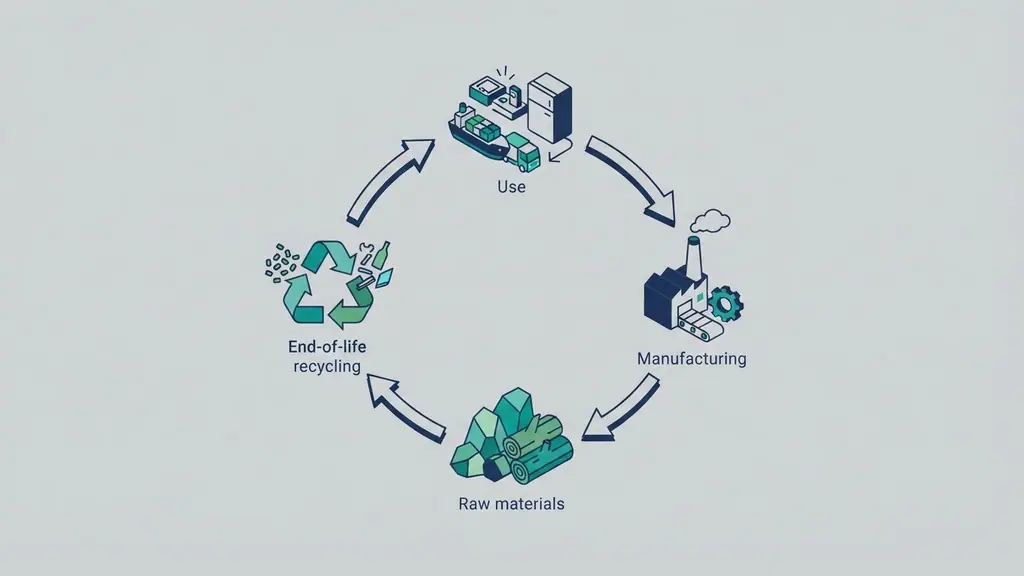
LCA is a structured method for adding up the environmental burdens of a product or service across its whole life: raw material extraction, manufacture, transport, use and end of life. It is defined by two international standards, ISO 14040 (principles and framework) and ISO 14044 (requirements and guidelines). Both were published in 2006; ISO 14040 was amended in 2020, and ISO 14044 in 2017 and 2020. This article covers the four phases those standards set out, the choices that most often decide the result, and a worked example of how an LCA can reverse an intuitive conclusion.
The four phases defined by ISO 14040/14044
ISO 14040 describes LCA as four connected phases. The work is iterative: findings in later phases often send the analyst back to revise earlier ones.
- Goal and scope definition. Why is the study being done, who is it for, and will it be used to make public comparative claims? This phase fixes the functional unit, the system boundary, the impact categories and the data quality requirements.
- Life cycle inventory (LCI). Every relevant input (materials, energy, water) and output (emissions to air, water and soil, waste) is quantified for each process inside the boundary and scaled to the functional unit.
- Life cycle impact assessment (LCIA). Inventory flows are assigned to impact categories such as climate change, acidification or eutrophication, then multiplied by characterisation factors to produce category indicators.
- Interpretation. Results are checked for completeness, sensitivity and consistency, and conclusions, limitations and recommendations are drawn in light of the goal.
ISO 14044 adds one requirement practitioners should know. If a study supports a comparative assertion that will be disclosed to the public, such as "product A has a lower impact than product B", it must undergo a critical review by a panel of interested parties.
Functional unit and system boundary: where most studies are won or lost
The functional unit describes the service delivered, not the object. "One circulator pump" is a poor functional unit, because two pumps may deliver different flows over different lifetimes. "Circulating 1.5 m³/h against 4 m of head for 10 years in a domestic heating system" lets dissimilar designs be compared fairly.
The system boundary says which life stages and processes are included. Common boundary types are:
| Boundary | Stages included | Typical use |
|---|---|---|
| Cradle-to-gate | Extraction to factory gate | Environmental Product Declarations for construction materials |
| Cradle-to-grave | Extraction, manufacture, distribution, use, end of life | Consumer and building products |
| Cradle-to-cradle | As above, with recovery feeding new products | Circular design studies |
| Gate-to-gate | One manufacturing site or process | Process optimisation |
Cut-off rules decide which minor flows can be left out. The usual approach is a mass, energy or environmental-significance threshold, set in advance and reported.
Building the inventory
Inventory work is where most of the effort goes. Analysts combine foreground data, measured or supplied for the specific system (bill of materials, factory energy use, measured product power draw), with background data from databases for generic processes such as electricity generation, steel production or road freight. The European Commission's Joint Research Centre maintains the European Platform on LCA, which hosts guidance and data-network resources for this purpose.
Two inventory issues need special care:
- Multi-functional processes. A refinery produces many fuels, and a sawmill produces timber as well as sawdust. ISO 14044 sets out a hierarchy: avoid allocation where possible, by subdividing the process or expanding the system, and only then allocate burdens by physical relationships or, failing that, by another basis such as economic value. The 2020 amendment to ISO 14044 added an informative annex on allocation.
- Recycling and end of life. How credit for recycled content and for recyclability is shared between the first and second life changes results significantly, especially for metals. State the method and keep it consistent.
From inventory to impact
In LCIA, each inventory flow is multiplied by a characterisation factor for the relevant category. For climate change the factor is the global warming potential (GWP), conventionally over a 100-year horizon, expressing each gas in kilograms of CO₂-equivalent. GWP values are published by the Intergovernmental Panel on Climate Change and are revised between assessment reports, so a study should name the source it used.
Category indicator = Σ (inventory flowi × characterisation factori)
Climate change is rarely the only category that matters. The European Commission's Environmental Footprint method, for example, covers 16 impact categories, including particulate matter, water use, land use and resource depletion. A design that cuts carbon by switching to a battery or a bio-based material may shift burdens into mineral depletion or land use. Shifts like this are exactly what a multi-category LCA is designed to expose.
ISO 14044 treats normalisation (relating results to a reference, such as one person's annual impact) and weighting (combining categories into a single score) as optional steps. Weighting involves value choices, and ISO 14044 does not allow it to be used for comparative assertions disclosed to the public.
Worked example: two circulator pumps
Consider an illustrative comparison of two pumps delivering the same functional unit over 10 years and running 5,000 hours a year. The figures are invented for teaching and kept deliberately simple: only manufacturing and use-phase electricity are counted.
| Pump A | Pump B | |
|---|---|---|
| Manufacturing and materials (kg CO₂e) | 40 | 55 |
| Average electrical input (W) | 25 | 15 |
| Electricity over 10 years (kWh) | 25 W × 5,000 h × 10 = 1,250 | 15 W × 5,000 h × 10 = 750 |
| Use phase at 0.25 kg CO₂e/kWh | 312.5 | 187.5 |
| Total (kg CO₂e) | 352.5 | 242.5 |
Pump B has a 15 kg CO₂e manufacturing penalty but saves 125 kg CO₂e in use. It is clearly better on a grid with an emission factor of 0.25 kg CO₂e/kWh.
The interpretation phase now asks how robust that conclusion is. Re-run the use phase with a heavily decarbonised grid at 0.05 kg CO₂e/kWh:
- Pump A: 40 + 1,250 × 0.05 = 102.5 kg CO₂e
- Pump B: 55 + 750 × 0.05 = 92.5 kg CO₂e
Pump B still wins, but the margin shrinks from about 31% to about 10%. On an even cleaner supply, or with a shorter operating life, the ranking could flip. This is the kind of sensitivity analysis ISO 14044 expects. It also explains a wider trend: as grids decarbonise, embodied impacts make up a growing share of the total, which is why repair and longer service lives get so much attention. The trade-off is explored further in our article on the environmental case for repairing equipment. To try your own figures for an efficiency upgrade, use the carbon savings calculator.
Where LCA connects to other tools
LCA sits alongside several related frameworks, and confusing them causes errors.
- Environmental Product Declarations (EPDs) are third-party-verified LCA results published under a product category rule. For construction products in Europe, EN 15804 sets the core rules. EPDs are the main data source for whole-building carbon assessments.
- Corporate carbon footprints follow the GHG Protocol and cover an organisation rather than a product. Scope 3 categories such as purchased goods and use of sold products draw directly on LCA data. Our practical guide to Scope 1, 2 and 3 emissions explains the link.
- Circular economy metrics track material flows and retained value. LCA tests whether a circular strategy actually reduces impacts once transport, reprocessing energy and quality losses are counted. See circular economy principles for engineers.
- Battery and electronics studies are a fast-growing application. Results depend heavily on cell chemistry, manufacturing electricity and end-of-life assumptions, as discussed in recycling lithium-ion batteries.
Common pitfalls
- Comparing studies with different scopes. A cradle-to-gate figure for one material cannot be compared with a cradle-to-grave figure for another.
- Hidden use-phase assumptions. Operating hours, load profiles and grid factors often dominate the result and deserve the most scrutiny.
- Out-of-date background data. Electricity mixes change quickly, and an inventory built on a ten-year-old grid factor can mislead.
- Single-score reporting. Weighting hides trade-offs. Report the category results as well.
- False precision. Reporting 352.47 kg CO₂e implies an accuracy no LCA possesses. Round sensibly and show uncertainty ranges where you can.
A checklist before you commission or read an LCA
- Is the goal stated, including the intended audience and whether comparative public claims will be made?
- Does the functional unit describe a service, with a defined lifetime?
- Are the system boundary and cut-off criteria explicit and the same for every option compared?
- Are the data sources, geography and reference years listed for foreground and background data?
- Is the allocation and recycling method named and justified?
- Which impact categories are reported, and which characterisation method and GWP values were used?
- Is there a sensitivity analysis on the parameters that dominate the result, such as grid factor, lifetime and usage?
- For public comparative claims, has an ISO 14044 critical review been carried out?
Done well, LCA is one of the most useful tools an environmental engineer has. It gives a defensible, quantified basis for choosing between designs. Done carelessly, it gives a confident-looking number that says more about the assumptions than about the product.
References
- ISO 14040:2006 Environmental management: Life cycle assessment, Principles and framework. International Organization for Standardization
- ISO 14044:2006 Environmental management: Life cycle assessment, Requirements and guidelines. International Organization for Standardization
- European Platform on LCA (EPLCA). European Commission Joint Research Centre
- AR6 Climate Change 2021: The Physical Science Basis. Intergovernmental Panel on Climate Change