Circular Economy Principles for Engineers
A practical engineering guide to the circular economy: core principles, inner and outer loops, design for disassembly, EU ecodesign rules and pitfalls.

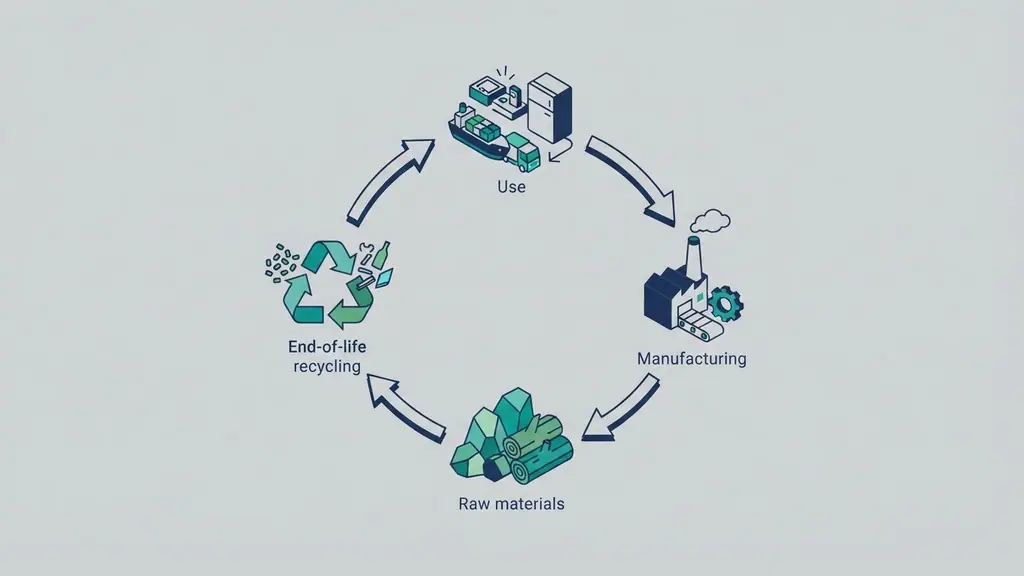
Most engineering education still teaches a linear model without naming it: specify a material, form it into a product, use the product, then hand the remains to someone else's waste stream. The circular economy asks engineers to design the whole loop instead. Products and materials should keep their value for as long as possible, and leftovers should become inputs rather than pollution.
For engineers the idea becomes practical quickly. It shows up as fastener choices, material selection, modular architectures, maintenance regimes, take-back logistics and, increasingly, legal requirements. This article sets out the core principles, translates them into design strategies and explains where circularity and energy efficiency support each other and where they pull apart.
The three principles
The Ellen MacArthur Foundation, which has done much to popularise the concept, frames the circular economy around three principles, all driven by design:
- Eliminate waste and pollution. Treat waste and pollution as design flaws, not inevitable by-products.
- Circulate products and materials at their highest value. Keep components and materials in use, preferring options that preserve the most embedded value and effort.
- Regenerate nature. Return biological nutrients safely to the soil and favour practices that rebuild natural systems rather than deplete them.
The Foundation's "butterfly" diagram separates technical cycles (metals, polymers, electronics, kept in circulation through maintenance, reuse, remanufacture and recycling) from biological cycles (food, timber, natural fibres, which can safely return to the biosphere). One of the most common design errors is mixing the two, for example bonding a biodegradable fibre to a synthetic resin so that neither can be recovered.
Inner loops first
The key insight for engineers is that loops are not equal. A tighter loop keeps more of the energy, labour and capital that went into the product. A widely used framework, the "R-ladder", ranks strategies from most to least value-preserving:
| Strategy | What it means | Value retained |
|---|---|---|
| Refuse / rethink | Deliver the function differently, or share the asset | Highest |
| Reduce | Use less material and energy for the same function | |
| Reuse | Another user takes the product as is | |
| Repair / maintain | Restore function and extend life | |
| Refurbish | Bring an old product up to date | |
| Remanufacture | Rebuild to as-new specification using recovered parts | |
| Repurpose | Use components in a different product or function | |
| Recycle | Recover materials | |
| Recover energy | Incinerate with energy recovery | Lowest |
Recycling, the strategy most people associate with circularity, sits near the bottom. Shredding a gearbox to recover steel throws away the precision machining, heat treatment and assembly that made it a gearbox. Remanufacturing keeps most of that work.
Worked example: what an inner loop preserves
Consider an illustrative 15 kW industrial gearmotor. The numbers below are hypothetical, chosen to show the reasoning rather than to describe a real product.
- New unit: embodied impact of 600 kg CO₂e.
- Remanufacture: housing and gear set reused; bearings, seals and winding insulation replaced; re-machining, cleaning and testing included. Assume the process adds 120 kg CO₂e.
- Recycle and replace: the old unit is shredded and a new one bought. Assume the recycling credit for the recovered steel and copper is 150 kg CO₂e.
| Route | Calculation | Net impact (kg CO₂e) |
|---|---|---|
| Remanufacture | 120 | 120 |
| Recycle old, buy new | 600 − 150 | 450 |
On these assumptions remanufacturing has about a quarter of the impact of the recycle-and-replace route. The comparison is only valid if both routes deliver the same function. If the remanufactured unit were markedly less efficient, its higher use-phase electricity could cancel the advantage. That is why a lifecycle assessment, rather than intuition, should settle close cases (see lifecycle assessment explained). The same logic applies to buildings plant and appliances, discussed in the environmental case for repairing equipment.
Design strategies that make circularity possible
Circular outcomes are largely set at the drawing board. The most effective strategies are rarely exotic:
Design for disassembly
- Use reversible fixings (screws, clips, bolts) instead of adhesives and welds where performance allows.
- Keep the number of fastener types and tool types small, and keep access paths clear.
- Mark polymer parts with their material code so recyclers can sort them.
Modularity and standardisation
- Separate parts that wear or become obsolete (bearings, batteries, control boards, filters) from long-lived structures (housings, frames).
- Use standard interfaces so a 2035 controller can fit a 2025 chassis.
Material choices
- Prefer mono-materials or easily separable combinations.
- Avoid substances of concern that contaminate recycling streams.
- Specify recycled content where it does not compromise safety-critical performance.
Information
- Record materials, components and repair instructions in a form that will still be readable in 20 years. The EU's Digital Product Passport, introduced under the Ecodesign for Sustainable Products Regulation, is intended to do this at scale.
Business models
- Leasing, performance contracts and "product-as-a-service" arrangements keep ownership with the manufacturer. That gives the manufacturer a direct financial interest in durability and recovery.
The European policy context
Circularity has moved from voluntary principle to regulation in the EU.
- Circular Economy Action Plan (March 2020). The Commission's second action plan made sustainable product design, repair and waste prevention central to EU policy, with a focus on electronics, batteries, packaging, plastics, textiles and construction.
- Ecodesign for Sustainable Products Regulation, (EU) 2024/1781. In force since July 2024, it extends ecodesign beyond energy-related products. It allows product-specific rules on durability, reparability, recycled content, availability of spare parts and information requirements, including the Digital Product Passport.
- Directive (EU) 2024/1799 on repair of goods. Member States had until 31 July 2026 to apply national rules. It creates obligations on manufacturers to repair certain products and measures to make repair more accessible to consumers.
- Sector rules. The Batteries Regulation, the WEEE Directive and the recast Energy Performance of Buildings Directive each add circularity provisions for their sectors.
For an engineer specifying products sold in the EU, these rules increasingly turn good practice into compliance requirements.
Where circularity and energy efficiency meet, and where they conflict
For a publication focused on energy, the interaction deserves attention.
Synergies. Material efficiency is energy efficiency upstream. Primary metals, cement and glass are energy-intensive to produce, so every kilogram not needed, or reused, avoids that energy. As electricity grids decarbonise, these embodied impacts become a larger share of a product's lifecycle footprint, which strengthens the case for longer lives and inner loops.
Tensions.
- Efficiency upgrades versus life extension. Keeping a very inefficient motor, chiller or boiler running can cost more energy than replacing it. Where use-phase energy dominates, an early upgrade can be the lower-impact choice.
- Rebound. Cheaper refurbished goods can increase total consumption.
- Quality loss. Many recycling routes downcycle materials. Mixed aluminium alloys and contaminated plastics often cannot return to their original application.
- Reverse logistics. Collecting, sorting and transporting used products takes energy. For bulky, low-value items, the logistics can erode the benefit.
The answer is not to rank circularity above efficiency, or the reverse, but to compare options on a lifecycle basis using the carbon savings calculator for operational effects and LCA data for embodied effects.
Measuring progress
Engineers need indicators that can be tracked. Useful ones include:
- Recycled content (% by mass) and recyclability under realistic, not theoretical, recovery routes.
- Product lifetime and mean time between failures, alongside repairability scores where a scheme exists.
- Material Circularity Indicator, a product-level metric developed by the Ellen MacArthur Foundation and partners that combines recycled input, recovery at end of life and lifetime relative to an industry average.
- Lifecycle impact per functional unit, which keeps the focus on environmental outcomes rather than circularity for its own sake.
Practical steps for an engineering team
- Identify the three components that fail or become obsolete first in your product, and redesign their access and fixings.
- Map every material and joining method. Flag permanent joints between dissimilar materials.
- Set a spare-parts and repair-information policy that matches the product's intended life.
- Run a simple lifecycle comparison before choosing between life extension and replacement for energy-using equipment.
- Check which EU product rules under the ESPR, the repair directive or sector legislation apply, or are expected to apply, to your product group.
- Track a small set of indicators, including at least one environmental outcome, and review them at each design iteration.
Circularity is not a separate discipline bolted onto engineering. It is the familiar engineering task of meeting a function with the least resource, extended across the whole life of the product and beyond.
References
- Circular economy principles. Ellen MacArthur Foundation
- Circular economy action plan. European Commission
- Regulation (EU) 2024/1781 establishing a framework for the setting of ecodesign requirements for sustainable products. EUR-Lex
- Directive (EU) 2024/1799 on common rules promoting the repair of goods. EUR-Lex