Solar Thermal Systems for Hot Water and Process Heat
How solar thermal collectors work, how to read the collector efficiency equation, sizing for hot water, solar fraction, Legionella control and industrial uses.
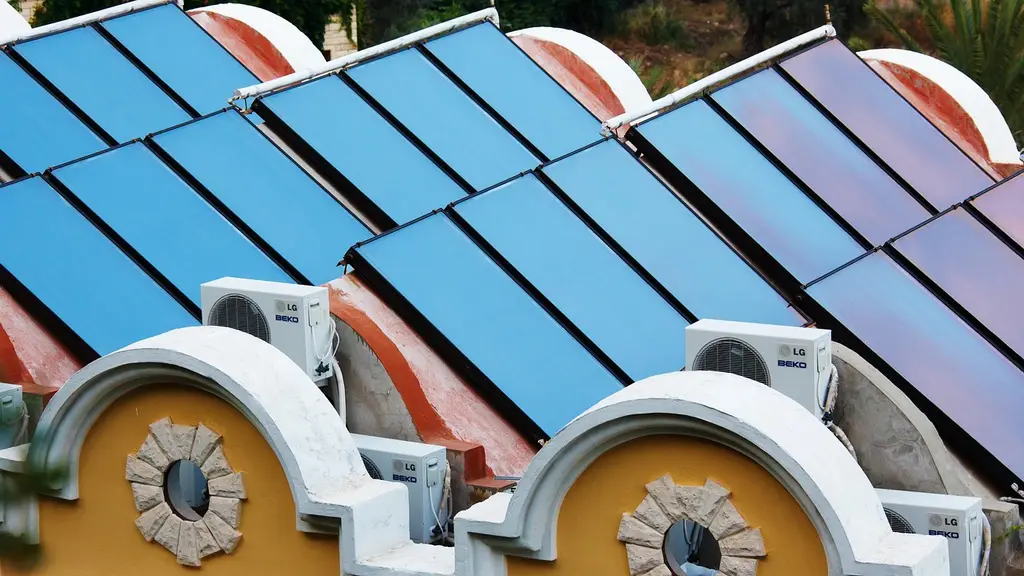
Solar electricity gets most of the attention, but for heating water the sun can be harnessed more directly. A solar thermal collector converts sunlight into heat with efficiencies that commonly exceed 50% under good conditions — more than twice the conversion efficiency of a typical PV module — and stores it in a tank of water at low cost. Worldwide, operational solar thermal capacity stood at around 560 GW of thermal output (GWth) at the end of 2023, according to the IEA Solar Heating and Cooling Programme's Solar Heat Worldwide 2024.
This article explains the main collector types, how to read the collector efficiency equation that governs their performance, how to size a hot-water system, and where solar thermal fits alongside heat pumps and PV. It also covers the hygiene and overheating issues that any designer must address.
Collector types
Solar thermal collectors absorb solar radiation on a dark surface and transfer the heat to a fluid. They differ mainly in how they limit heat loss back to the environment.
| Type | Construction | Typical operating range | Strengths | Limitations |
|---|---|---|---|---|
| Unglazed | Bare absorber, often polymer | Up to about 30–40 °C | Cheap, simple | High losses; mainly pools |
| Flat-plate | Selective absorber behind glass in an insulated box | Domestic hot water, space heating | Robust, good value, high optical efficiency | Losses rise quickly at higher temperatures |
| Evacuated tube | Absorber inside vacuum glass tubes | Hot water, space heating, low-temperature process heat | Very low heat loss; good in cold weather | Higher cost; lower optical efficiency per gross area |
| Concentrating (parabolic trough, Fresnel) | Mirrors focus beam radiation on a receiver | Process heat above about 100 °C | High temperatures | Needs direct sunlight and tracking |
The collector efficiency equation
Collector performance is measured under the international standard EN ISO 9806 and summarised in a quadratic efficiency curve:
η = η0 − a1 × (Tm − Ta) ÷ G − a2 × (Tm − Ta)² ÷ G
where η0 is the optical (zero-loss) efficiency, a1 and a2 are heat-loss coefficients (W/m²K and W/m²K²), Tm is the mean fluid temperature, Ta the ambient temperature and G the irradiance on the collector (W/m²).
The equation reveals the central trade-off. Efficiency is highest when the collector runs close to ambient temperature and falls as the temperature difference grows, especially in weak sunshine.
Worked example: flat-plate versus evacuated tube
Take representative coefficients of the kind found in test reports — a flat-plate collector with η0 = 0.78, a1 = 3.5, a2 = 0.015, and an evacuated tube collector with η0 = 0.65, a1 = 1.2, a2 = 0.008 — at an irradiance of 800 W/m².
| Temperature difference Tm − Ta | Flat-plate η | Evacuated tube η |
|---|---|---|
| 10 K (pre-heating, pools) | 0.78 − 0.044 − 0.002 ≈ 0.73 | 0.65 − 0.015 − 0.001 ≈ 0.63 |
| 50 K (hot water in cool weather) | 0.78 − 0.219 − 0.047 ≈ 0.51 | 0.65 − 0.075 − 0.025 ≈ 0.55 |
| 80 K (process heat) | 0.78 − 0.350 − 0.120 ≈ 0.31 | 0.65 − 0.120 − 0.064 ≈ 0.47 |
At low temperature differences, the flat-plate collector's higher optical efficiency wins. At high temperature differences — winter operation, space heating, process heat — the evacuated tube's lower losses take over. The right choice depends on the application's temperature, not on which technology is "better" in general. (Always compare collectors on the same reference area, gross or aperture, as test reports specify.)
System configurations
Most building systems fall into a few configurations:
- Thermosiphon systems place the tank above the collector; heated water rises naturally, with no pump. They are common in warm climates where freezing is rare.
- Pumped (forced-circulation) systems use a pump and differential controller to circulate fluid when the collector is warmer than the tank. Most systems in colder climates use a glycol antifreeze loop with a heat exchanger in the store.
- Drainback systems empty the collector loop into a reservoir when the pump stops, protecting against both freezing and overheating without antifreeze.
- Combi-systems supply both hot water and space heating, usually with a larger buffer store.
The store is as important as the collector. Good thermal stratification — hot water at the top, cold at the bottom — keeps the collector inlet cool, which, as the efficiency equation shows, raises yield.
Sizing for domestic hot water
The energy needed to heat water is:
Q = m × cp × ΔT
where m is mass of water, cp ≈ 4.19 kJ/kgK and ΔT is the temperature rise.
Consider an illustrative household using 200 litres of hot water a day, heated from 10 °C to 60 °C:
Q = 200 kg × 4.19 kJ/kgK × 50 K ≈ 41,900 kJ ≈ 11.6 kWh/day
That is about 4,250 kWh a year before standing losses from the tank and pipework. If a 4 m² collector array delivers an assumed 450 kWh per m² per year of useful heat to the store at this site, it supplies about 1,800 kWh, giving a solar fraction of roughly 1,800 ÷ 4,250 ≈ 42% of the hot-water heat requirement. In practice, losses and the mismatch between sunny periods and demand mean designers rely on simulation tools, and in temperate climates domestic systems are often designed for solar fractions in the region of 50–60% for hot water, with near-complete coverage in summer and little in winter. Oversizing to raise the annual fraction leads to long periods of overheating in summer, so diminishing returns set in quickly.
Overheating, stagnation and hygiene
Two design issues distinguish good solar thermal systems from troublesome ones.
Stagnation. When the store is fully heated and the pump stops, collectors can reach very high temperatures — well above 150 °C for good evacuated tubes. The system must tolerate this safely: correctly sized expansion vessels, high-temperature components, and glycol that will not degrade. Drainback designs avoid most stagnation problems.
Legionella. Stored warm water between roughly 20 °C and 45 °C can support Legionella bacteria. Health and safety guidance, such as that from the UK Health and Safety Executive, generally recommends storing hot water at 60 °C or above and distributing it so that it reaches at least 50 °C at outlets. Solar pre-heat stores operating at lower temperatures need a strategy, such as periodic pasteurisation by the auxiliary heater or a design in which the pre-heat volume is small and passes through a hotter store.
Safety: Solar thermal systems can produce scalding water and very hot pipework, and contain pressurised fluids. Install thermostatic mixing valves where required, use appropriately rated components, and have systems designed and installed by competent installers following manufacturer instructions and national regulations.
Beyond the house: process heat and district heating
A large share of industrial heat demand is at low and medium temperatures — washing, pasteurising, drying, preheating boiler feedwater — which suits solar collectors. Solar heat for industrial processes is still a small market but technically mature, particularly where demand is steady through the week and the year. Large ground-mounted collector fields also feed district heating networks, with Denmark the best-known example, often combined with large seasonal or multi-day thermal stores. Thermal storage options are discussed further in energy storage for buildings.
Solar thermal, PV or heat pump?
Solar thermal now competes with alternatives for both roof space and budget. PV paired with a heat pump or an electric immersion heater offers flexibility — surplus electricity can serve any load or be exported — and simpler plumbing. Solar thermal offers higher energy capture per square metre and cheap storage in water. It remains attractive where hot-water demand is high and steady (hotels, care homes, sports centres, food processing), where roof space is scarce, and in sunny climates where thermosiphon systems are inexpensive. For a comparison with electricity generation from the same roof, see rooftop solar PV, and for the full renewable landscape our engineer's overview of renewable energy technologies.
Design checklist
- Match collector type to operating temperature using the efficiency equation.
- Size for a realistic solar fraction and avoid summer overheating.
- Design the store for stratification and keep collector return temperatures low.
- Provide safe handling of stagnation: expansion, component ratings, or drainback.
- Implement a Legionella control strategy consistent with national guidance.
- Fit heat metering so that delivered solar energy can be verified.
References
- Solar Heat Worldwide 2024. IEA Solar Heating and Cooling Programme
- IEA Solar Heating and Cooling Programme. IEA SHC
- Solar Water Heaters. US Environmental Protection Agency, ENERGY STAR
- Legionnaires' disease. UK Health and Safety Executive