Energy Storage for Buildings: Batteries and Thermal Stores
Batteries, hot-water stores, ice and phase-change storage compared for buildings: energy density, efficiency, peak-shaving sizing and safety standards.
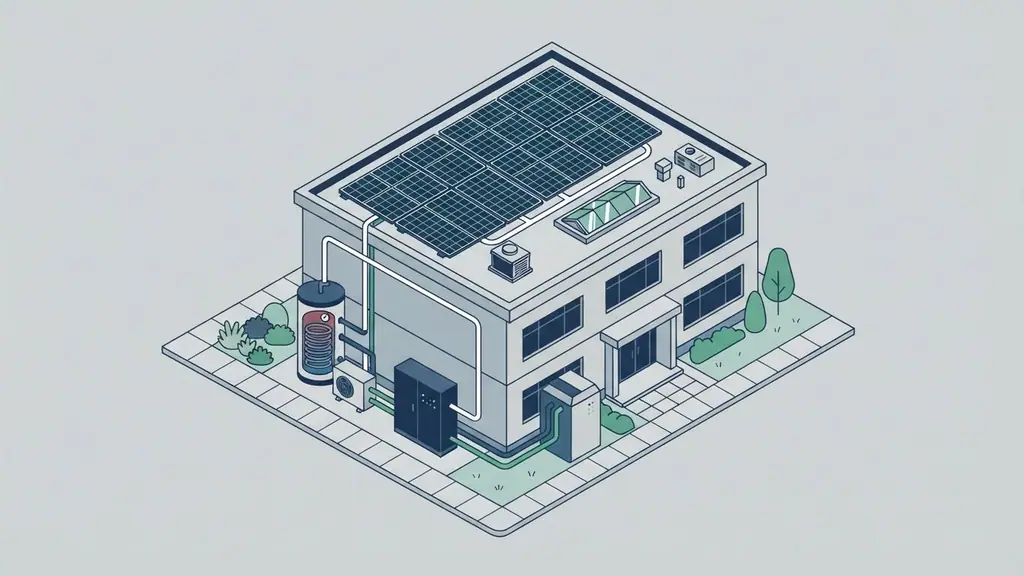
Buildings have always stored energy — in oil tanks, coal bunkers and hot-water cylinders. What has changed is the reason. With more on-site solar generation, electrified heating and time-varying tariffs, the value of energy increasingly depends on when it is used. Storage lets a building decouple generation or purchase from consumption: soaking up midday solar, cutting expensive demand peaks, or riding through a power cut.
The default assumption is that "storage" means a lithium-ion battery. Often it does. But for heating and cooling — the largest energy uses in most buildings — thermal storage can be far cheaper per kilowatt-hour stored. This article compares the main options, shows how to estimate capacity for each, works through a peak-shaving battery sizing example, and sets out the safety framework for stationary batteries.
What storage is for
The right technology depends on the job. In buildings, storage typically serves one or more of these purposes:
- Increasing self-consumption of on-site PV, by storing midday surplus for evening use. See rooftop solar PV for how self-consumption is calculated.
- Peak shaving: limiting maximum demand to reduce capacity charges or avoid a grid connection upgrade.
- Load shifting / tariff arbitrage: buying electricity when it is cheap and using it when it is expensive.
- Resilience: supplying critical loads during outages.
- Grid services: providing flexibility to network operators or aggregators, for payment.
- Thermal load shifting: producing heat or cooling at efficient or cheap times and using it later.
A single installation can stack several of these, but they can conflict: a battery kept full for resilience cannot simultaneously absorb solar surplus.
Batteries: chemistry, efficiency and life
Most building-scale batteries are lithium-ion, in two main chemistries:
| Feature | Lithium iron phosphate (LFP) | Nickel manganese cobalt (NMC) |
|---|---|---|
| Energy density | Lower | Higher |
| Cycle life | Generally longer | Generally shorter |
| Thermal stability | Higher; less prone to thermal runaway | Lower |
| Typical use | Stationary storage, increasingly dominant | Electric vehicles, space-constrained installations |
Two performance numbers matter most. Round-trip efficiency is the energy you get out divided by the energy put in, including inverter and auxiliary losses. The Annual Technology Baseline from the National Laboratory of the Rockies (formerly NREL) has used 85% as a representative planning value for utility-scale lithium-ion systems, and the US Energy Information Administration found the average monthly round-trip efficiency of the US utility-scale battery fleet was about 82% in 2019. Small behind-the-meter systems with standby consumption can do worse at low utilisation.
Usable capacity and life: manufacturers specify usable energy (not all nominal capacity is available), a cycle or throughput warranty, and an end-of-warranty capacity, often expressed as a percentage of the original. Capacity fades with cycling, time and temperature; see battery degradation and lifecycle. Batteries retired from vehicles can sometimes be reused in stationary applications, provided their condition is assessed carefully and the system is designed for their reduced and more variable capacity.
Worked example: sizing a peak-shaving battery
Consider an illustrative commercial building whose half-hourly data show a maximum demand of 400 kW, occurring on weekday afternoons in summer when chillers run hard. The owner wants to cap demand at 340 kW to reduce capacity charges.
- Power rating. The battery must discharge at least 400 − 340 = 60 kW, plus a margin for forecast error — say 70 kW.
- Energy. Analysis of the load profile shows that demand exceeds 340 kW for up to about two hours on the worst days, with an average excess of around 45 kW over that period and a peak excess of 60 kW. The energy required on the worst day is therefore around 45 kW × 2 h = 90 kWh delivered. Allowing a margin for unusual days, the target becomes 120 kWh delivered.
- Usable versus nominal. If the system allows 90% of nominal capacity to be used and discharge losses are already counted in the delivered figure, nominal capacity is 120 ÷ 0.9 ≈ 133 kWh.
- Recharge. The battery must recharge overnight or in the morning without creating a new peak — straightforward here, since night-time demand is low.
The financial case then compares the capacity charge saved, plus any secondary value such as tariff arbitrage, against capital cost, efficiency losses and degradation. The crucial input is good interval data: a battery sized on monthly bills is guesswork.
Thermal storage: sensible, latent and the physics of cheap storage
Thermal storage holds energy as heat or "coolth". It comes in two broad forms.
Sensible storage raises or lowers the temperature of a material, usually water:
Q = m × cp × ΔT
For one cubic metre of water (about 1,000 kg, cp ≈ 4.19 kJ/kgK) heated through 40 K:
Q = 1,000 × 4.19 × 40 ÷ 3,600 ≈ 46.6 kWhth
Latent storage uses a phase change. Freezing water releases about 334 kJ/kg, so one cubic metre of ice (about 917 kg) stores:
Q = 917 × 334 ÷ 3,600 ≈ 85 kWhth
— nearly twice the sensible example, and at a constant temperature, which suits chilled-water systems. Phase-change materials (PCMs) with melting points tailored to heating or cooling applications offer similar advantages in compact form, though at higher cost.
The practical significance is that a heat pump with a hot-water buffer, or a chiller with an ice or chilled-water store, can shift large amounts of energy at modest cost. A water tank is simple, long-lived, and has no cycle-life degradation in the battery sense; its main losses are standing heat losses through the insulation.
Comparing the options
| Option | Stores | Indicative energy per m³ | Main losses | Typical role |
|---|---|---|---|---|
| Lithium-ion battery | Electricity | Hundreds of kWh per m³ at cell level, less for installed systems | Conversion (round trip about 80–90%) | PV self-consumption, peak shaving, backup |
| Hot-water store (40 K swing) | Heat | About 47 kWhth | Standing heat loss | Heat-pump and solar thermal buffering, load shifting |
| Ice store | Cooling | About 85 kWhth latent | Chiller efficiency penalty at low temperatures | Shifting cooling to night |
| Phase-change material | Heat or cooling | Varies with material | Standing loss; cost | Space-constrained thermal storage |
| Building thermal mass | Heat or cooling | Small but free | Comfort constraints | Pre-heating and pre-cooling |
The comparison is not apples-to-apples: a kilowatt-hour of heat from a store displaces only a fraction of a kilowatt-hour of electricity when the alternative is a heat pump with a COP of three. Even so, thermal storage frequently delivers load flexibility at a fraction of the cost of the equivalent battery. Note the efficiency trade-off too: making ice requires lower evaporator temperatures than producing chilled water, which reduces chiller efficiency. Pairing storage with heat pumps and smart charging of electric vehicles gives buildings a substantial, controllable flexible load.
Safety and standards for stationary batteries
Lithium-ion batteries store a great deal of energy in a small volume and can fail through thermal runaway, a self-heating reaction that can lead to fire and the release of flammable and toxic gases. The underlying mechanisms are explained in battery safety and thermal runaway.
Safety: Stationary battery systems must be designed, installed and maintained by qualified professionals in line with manufacturer instructions and applicable codes. Relevant standards include IEC 62619 (safety of industrial lithium cells and batteries), the IEC 62933 series (electrical energy storage systems), UL 9540 and the UL 9540A fire test method, and NFPA 855 for installation in North America, alongside national electrical and fire regulations. Consider location, separation from escape routes, ventilation, fire detection and suppression, and access for emergency services. Never attempt to open, modify or repair lithium-ion battery packs.
Thermal stores have their own hazards — pressurised hot water, scalding, and in hot-water stores the need to manage Legionella risk — but these are well understood and covered by established plumbing and heating practice.
Choosing and specifying storage
- Define the purpose — self-consumption, peak shaving, resilience, flexibility — and quantify its value.
- Get interval data for electricity, and ideally for heat, before sizing anything.
- Check thermal options first for heating and cooling loads; they are often cheaper per unit of flexibility.
- Size batteries on power and energy separately, using worst-case days from real profiles.
- Specify usable capacity, round-trip efficiency, warranty terms and end-of-warranty capacity, not just nominal kWh.
- Plan controls: storage only delivers value if it charges and discharges at the right times.
- Address safety and siting at the design stage, with the fire authority where required.
Storage is one part of a wider integration challenge for renewables, introduced in our engineer's overview of renewable energy technologies.
References
- Utility-Scale Battery Storage — Annual Technology Baseline. National Laboratory of the Rockies (formerly NREL)
- Utility-scale batteries and pumped storage return about 80% of the electricity they store. US Energy Information Administration
- Batteries and Secure Energy Transitions. International Energy Agency
- NFPA 855: Standard for the Installation of Stationary Energy Storage Systems. National Fire Protection Association