Heat Pumps Explained: COP, SCOP and Real-World Performance
How heat pumps work and how to read their efficiency figures: COP, Carnot limits, SCOP under EN 14825, field SPF, flow temperatures and running-cost break-even.
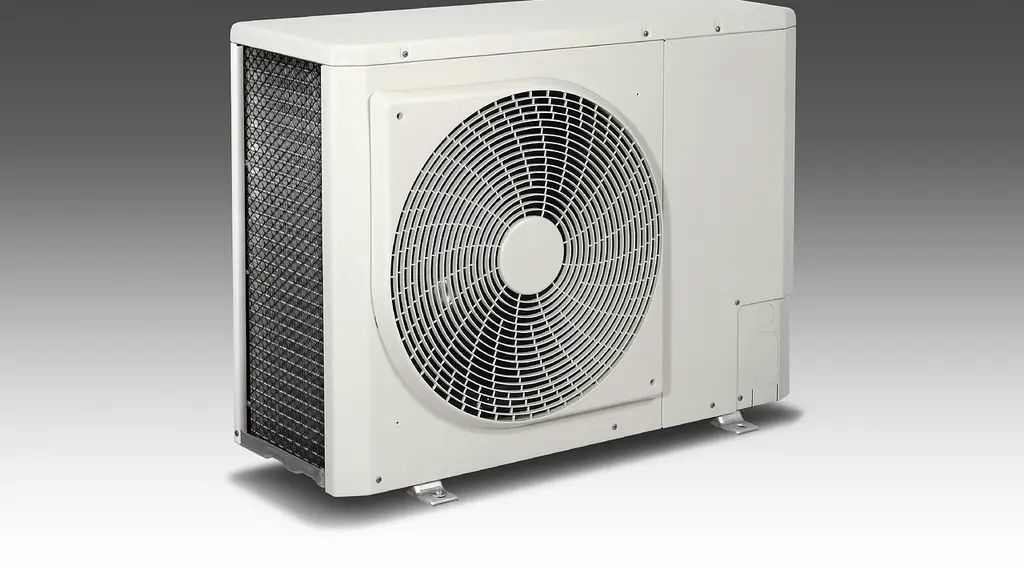
A gas boiler, at best, turns one kilowatt-hour of fuel into slightly less than one kilowatt-hour of heat. A heat pump turns one kilowatt-hour of electricity into three, four or more kilowatt-hours of heat. That multiplication is not a trick: the extra energy is drawn from the outdoor air, the ground or a body of water, and the electricity is used to move it "uphill" to a useful temperature.
That is why heat pumps sit at the centre of most plans to decarbonise heating. But their efficiency is not a fixed number. It depends on temperatures, on the building, on how the system is designed and on how it is controlled. This article explains the metrics — COP, SCOP and SPF — the thermodynamics behind them, what field measurements show, and what designers and owners can do to get the best real-world performance.
How a heat pump works
Almost all building heat pumps use the vapour-compression cycle, the same cycle as a refrigerator run in reverse:
- Evaporator: a cold refrigerant absorbs heat from the source (outdoor air, ground loop or water) and evaporates.
- Compressor: an electrically driven compressor raises the refrigerant's pressure and temperature.
- Condenser: the hot refrigerant releases heat to the building's heating water or air and condenses.
- Expansion valve: the refrigerant's pressure drops, cooling it so the cycle can begin again.
Many units are reversible and can provide cooling in summer. The main types for buildings are air-to-water (feeding radiators or underfloor heating), air-to-air (split and multi-split systems), ground-source (using borehole or horizontal collectors) and water-source units.
COP and the Carnot limit
The coefficient of performance (COP) is the ratio of useful heat delivered to electrical energy consumed at a given operating condition:
COP = Qheat ÷ Welectric
Thermodynamics sets an upper bound. For an ideal (Carnot) heat pump operating between a cold source at absolute temperature Tc and a hot sink at Th, both in kelvin:
COPCarnot = Th ÷ (Th − Tc)
The key insight is that COP depends on the temperature lift — the difference between source and sink. The smaller the lift, the higher the possible COP.
Worked example: why flow temperature matters
Consider outdoor air at 2 °C (275.15 K) and compare two heating-water flow temperatures:
- Flow at 35 °C (308.15 K), typical for underfloor heating: COPCarnot = 308.15 ÷ 33 ≈ 9.3
- Flow at 55 °C (328.15 K), typical for unmodified radiators: COPCarnot = 328.15 ÷ 53 ≈ 6.2
Real machines fall well short of Carnot because of heat-exchanger temperature differences, compressor losses, fans, pumps and defrost. As a purely illustrative assumption, suppose a machine achieves 45% of the Carnot value in both cases: the COPs would be about 4.2 at 35 °C and 2.8 at 55 °C. Whatever the exact fraction, the lesson holds — lowering the flow temperature by 20 K cuts the electricity needed for the same heat by about a third in this example. This is the single most important design lever for heat pump performance.
SCOP: seasonal performance on paper
A COP describes one operating point. Over a heating season, outdoor temperature varies, the heat pump runs at part load, and at very low temperatures a backup heater may be needed. The seasonal coefficient of performance (SCOP) captures this, calculated according to the European standard EN 14825 from tests at several conditions.
SCOP is calculated for reference climates defined in EU ecodesign and labelling rules. The "average" climate has a design temperature of −10 °C, with "colder" and "warmer" climates at −22 °C and +2 °C respectively. The average-climate SCOP must be declared for energy labelling; colder and warmer values may also be published. SCOP depends on the declared flow temperature — a product's SCOP at 35 °C (low-temperature application) is considerably higher than at 55 °C (medium-temperature application), so comparisons must be like-for-like.
SPF: what happens in real buildings
Field performance is described by the seasonal performance factor (SPF): measured heat output divided by measured electricity input over a period, usually a year. Unlike SCOP, SPF reflects the actual building, installation and controls. It also depends on the boundary chosen — whether the measurement includes circulation pumps, backup heaters and hot-water production. A common framework labels boundaries H1 (heat pump unit only) through H4 (including backup heaters and distribution pumps). Always check which boundary a reported SPF uses.
Real-world data are now substantial. The UK's Electrification of Heat demonstration project, which monitored heat pumps installed in a wide range of homes, reported in its interim analysis a median seasonal performance factor of about 2.8 for air-source heat pump systems, with a median of about 2.4 on the coldest days. Importantly, performance varied widely between installations, and well-designed systems performed considerably better than the median — a reminder that installation and design quality matter as much as the product.
| Metric | Measured where | Includes | Use it for |
|---|---|---|---|
| COP | Laboratory, single condition | Unit only, steady state | Comparing products at a defined point |
| SCOP | Calculated from lab tests (EN 14825) | Part load, reference climate, backup heat | Product comparison, energy labels |
| SPF | Installed system, measured | Real climate, building, controls (per boundary) | Verifying performance, running-cost estimates |
Running costs: the break-even ratio
Whether a heat pump saves money compared with a gas boiler depends on the ratio of electricity to gas prices. Consider an illustrative house with an annual heat demand of 12,000 kWh:
- Gas boiler at 90% seasonal efficiency: 12,000 ÷ 0.90 ≈ 13,330 kWh of gas
- Heat pump with SPF 3.0: 12,000 ÷ 3.0 = 4,000 kWh of electricity
The heat pump costs less to run whenever:
Electricity price ÷ gas price < SPF ÷ ηboiler = 3.0 ÷ 0.90 ≈ 3.3
If electricity costs three times as much as gas per kWh, the heat pump is slightly cheaper; at four times, the boiler is cheaper unless SPF improves. This simple ratio explains why heat pump economics differ so much between countries, and why raising SPF through good design — or using time-of-use tariffs and on-site solar PV — matters. Our calculators can help with tariff comparisons.
Design and operation: getting a high SPF
- Reduce heat loss first. Insulation and airtightness lower the required heat output and allow lower flow temperatures.
- Size the emitters for low flow temperatures. Larger radiators or underfloor heating allow 35–45 °C flow in place of 60–70 °C.
- Size the heat pump correctly. Oversized units cycle on and off; undersized units rely heavily on backup heaters.
- Use weather compensation. Adjusting flow temperature to outdoor temperature keeps the lift as small as possible for most of the season.
- Avoid unnecessary hot-water temperatures. Domestic hot water requires higher temperatures and lowers SPF, but stored hot water must be managed to control Legionella risk; follow national guidance.
- Mind defrost and siting. Air-source units in humid, near-freezing conditions defrost frequently. Good airflow around the outdoor unit and correct drainage help.
- Monitor. Heat and electricity meters make SPF visible. Without them, poor performance often goes unnoticed for years.
Safety: Heat pumps contain refrigerants under pressure, and some modern refrigerants such as propane (R290) are flammable. Installation, refrigerant handling and electrical connection must be carried out by appropriately certified installers following manufacturer guidance and national regulations.
Refrigerants and the bigger picture
Many heat pumps have historically used hydrofluorocarbon refrigerants with high global warming potential. The EU's revised F-gas Regulation, adopted in 2024, tightens restrictions considerably, and natural refrigerants such as propane and CO₂ are increasingly common. See refrigerants and climate for details. At larger scale, heat pumps also supply district heating networks, where waste heat from sewage, data centres or industry can provide a warm source and very high efficiency. The International Energy Agency treats heat pumps as a core technology for decarbonising heat because, powered by an increasingly low-carbon grid, they cut both energy use and emissions. For the place of heat pumps among other renewables, see our engineer's overview of renewable energy technologies.
Key takeaways
- COP depends on temperature lift; every degree of flow temperature reduction helps.
- SCOP is a standardised seasonal estimate; SPF is what the installed system actually achieves.
- Field data show wide variation; design, installation and controls are decisive.
- Running-cost savings depend on the electricity-to-gas price ratio relative to SPF divided by boiler efficiency.
- Metering heat and electricity is the only way to know how well a heat pump is really performing.
References
- The Future of Heat Pumps. International Energy Agency
- Heat pumps shown to be three times more efficient than gas boilers. Energy Systems Catapult
- Commission Delegated Regulation (EU) No 811/2013 (energy labelling of space heaters). EUR-Lex, European Union