Sustainable Last-Mile Transportation
How the final leg of urban delivery uses energy, and how electric vans, cargo bikes, micro-hubs and smarter routing cut kilowatt-hours per parcel.
A parcel can cross a continent on a fully loaded lorry or container ship using surprisingly little energy per kilogram. The expensive part, in money and in energy, is often the last few kilometres: a van crawling through traffic, stopping every couple of hundred metres, idling while a driver looks for a door number and sometimes coming back the next day because nobody was home.
This article looks at the last mile as an energy problem. It explains why stop-start delivery work is so inefficient, compares the main vehicle options using a worked example, and sets out the infrastructure (micro-hubs, depot charging, parcel lockers) that makes low-energy delivery practical. The goal is a framework a fleet manager, planner or energy manager can apply to their own routes.
Why the last mile wastes so much energy
Three physical features make urban delivery rounds energy-hungry.
Frequent stops. Every time a vehicle accelerates, it converts fuel or battery energy into kinetic energy, and every time it brakes with friction brakes, that energy becomes heat. Kinetic energy rises with mass and with the square of speed:
Ek = ½ · m · v²
A 3,000 kg loaded van at 30 km/h (8.3 m/s) carries about 104 kJ, or 0.029 kWh. That sounds small, but a round of 120 stops throws away roughly 3.5 kWh at the wheels. Because a diesel engine running in stop-start traffic might convert only around a quarter of its fuel energy into motion, that wheel energy can correspond to something like 14 kWh of fuel per day, purely to repeatedly get the van moving again.
Low load factors. A van leaves the depot full and returns empty, so on average it carries about half its capacity. Failed deliveries and returns push the effective figure lower still.
Idling and searching. Engines left running at the kerb, circling for loading space and congestion all add energy without adding delivered parcels. The ITF's work on urban freight highlights kerbside space as a recurring constraint: when there is nowhere legal to stop, vehicles double-park, circle or stop further away, all of which costs time and energy.
The options, from vehicle to system
Last-mile decarbonisation is not a single technology choice. It works at three levels.
1. Change the vehicle
Battery-electric vans address most of the inefficiencies above directly. Electric drivetrains are far more efficient than combustion engines: the US Department of Energy notes that electric vehicles convert over 77% of the electrical energy from the grid into power at the wheels, against roughly 12–30% of fuel energy for conventional petrol vehicles. They do not idle, and regenerative braking recovers part of the kinetic energy at each stop. Delivery rounds, with predictable daily distances and overnight return to base, suit battery vehicles well; range anxiety is rarely the binding constraint on dense urban work.
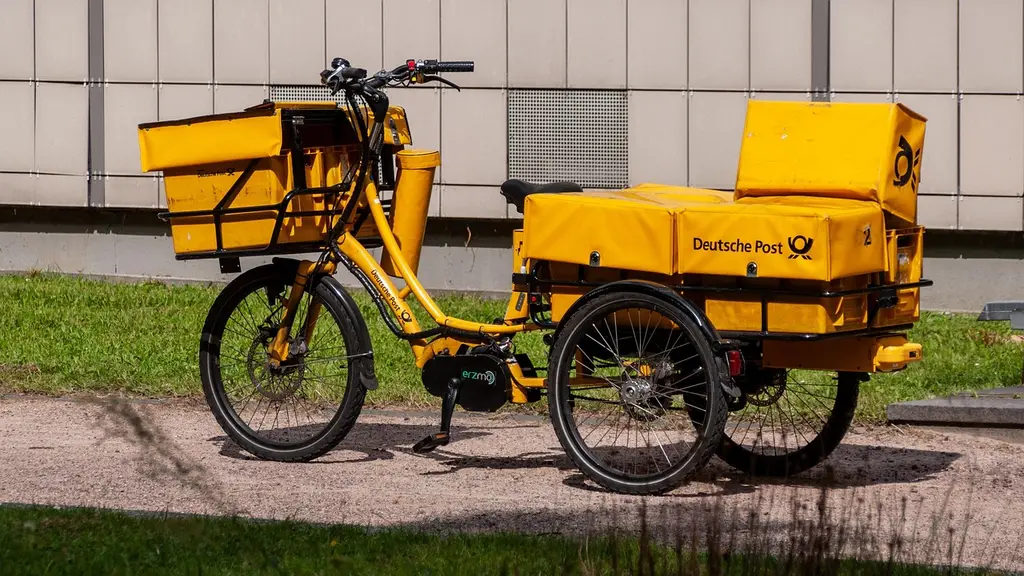
Electrically assisted cargo bikes and small electric light vehicles go further, cutting vehicle mass by an order of magnitude. Their energy consumption is measured in watt-hours per kilometre rather than tens or hundreds.
2. Change the network
Cargo bikes have limited payload and range, so they rarely work as a direct swap for a van from an out-of-town depot. They work when the network is redesigned around micro-hubs: small consolidation points in or near the delivery area, fed by a larger vehicle, from which bikes, walkers or small electric vehicles complete the final leg. The ITF's 2024 roundtable on urban logistics hubs describes this consolidate–sort–dispatch model and its potential to reduce the number of vehicles used in last-mile delivery.
3. Change the demand
Parcel lockers and pick-up points convert many scattered doorstep stops into a single consolidated drop. Flexible delivery windows, consolidated weekly business deliveries and better first-time delivery success all reduce kilometres before any vehicle technology is involved.
A worked comparison: one delivery round
Consider an illustrative inner-city round of 120 stops. Using a van from a depot, the round covers 60 km. The figures below are deliberately round numbers for illustration, not measurements of any specific vehicle. Energy is shown as final energy (fuel or electricity at the plug); upstream generation and refining are excluded.
| Scenario | Assumed consumption | Distance | Daily final energy |
|---|---|---|---|
| Diesel van from depot | 9 L/100 km (≈ 10 kWh/L) | 60 km | ≈ 54 kWh |
| Battery-electric van from depot | 25 kWh/100 km at the plug | 60 km | ≈ 15 kWh |
| Electric van shuttle to micro-hub, then three e-cargo bikes | 25 kWh/100 km (20 km shuttle) + 1.5 kWh/100 km (3 × 25 km by bike) | 95 km in total | ≈ 5 + 1.1 = 6.1 kWh |
The arithmetic for the last row: the shuttle uses 0.25 × 20 = 5 kWh; the bikes use 0.015 × 75 = 1.1 kWh. Even though the hub-and-bike system travels further in total, it uses around a ninth of the diesel van's final energy and well under half of the electric van's.
Two caveats keep this honest. First, the micro-hub itself has an energy and space cost (lighting, possibly heating, security) that needs to be counted. Second, the comparison assumes the bikes can actually carry the parcel mix; bulky or heavy items still need vans. In practice, most operators end up with a mixed fleet in which each vehicle type handles the work it suits.
Charging and depot energy
Electrifying a last-mile fleet moves the energy question from the forecourt to the depot. A depot with 60 electric vans each needing 15 kWh overnight requires about 900 kWh per night. Spread over a ten-hour window, that is an average of 90 kW, but if every van plugs into an 11 kW charger at 19:00 and charges immediately, the peak could reach 660 kW for an hour or so.
That difference is why load management matters. Staggering start times, prioritising vans by next-day route length and capping site demand can keep the grid connection modest, which often saves more money than any tariff. Our guide to smart charging and the grid covers the control strategies in detail. Where the depot has a large roof, rooftop PV can contribute, although it generates mainly during the day while delivery vans charge overnight; daytime charging of returning vehicles or stationary storage is needed to make good use of it.
E-cargo bikes have different needs: many small batteries, typically removable, charged in racks. The total energy is small, but the charging room deserves attention for fire safety. Our article on electric bicycle infrastructure discusses charging and storage design for light electric vehicles.
Safety: Charging installations for vans must be designed and installed by qualified electricians in line with national wiring rules and the relevant charging standards (for example IEC 61851 for charging systems and IEC 62196 for connectors). For cargo-bike batteries, use only the manufacturer's chargers, charge in a designated, ventilated area with detection and suppression appropriate to lithium-ion risks, and quarantine damaged packs. Never attempt to open or repair lithium-ion battery packs. See our explainer on battery safety and thermal runaway.
Policy is shaping the market
Regulation increasingly decides which vehicles can serve city centres. The Netherlands is a clear example: from 1 January 2025, Dutch municipalities could introduce zero-emission zones for city logistics, and a number of large cities, including Amsterdam, Rotterdam, Utrecht and The Hague, did so. New vans and trucks registered from that date need to be zero-emission to enter, while older Euro 5 and Euro 6 vehicles receive time-limited transitional access, with the last transitional exemptions due to expire on 1 January 2030. Rules vary by municipality, so operators must check each zone.
Elsewhere, kerbside management, loading bay booking, consolidation centre schemes and procurement rules for public bodies are steering last-mile logistics in the same direction. For the wider freight picture, including heavier vehicles and the EU's CO₂ standards for trucks, see decarbonising urban freight.
What good looks like in practice
The most effective last-mile programmes share a few features:
- They measure energy per delivery, not just per kilometre. A van that travels further but completes more drops may be more efficient per parcel.
- They match vehicle to task. Cargo bikes for dense, small-parcel areas; electric vans for bulky items and longer suburban loops; walking couriers for pedestrianised cores.
- They treat the depot as an energy asset. Grid connection, charging control and on-site generation are planned together.
- They work with the city. Hub locations, loading bays and access rules are negotiated rather than assumed.
Implementation checklist
- Baseline the current fleet: kilometres, stops, failed deliveries, fuel or electricity per day and per parcel.
- Map delivery density. Areas with many small parcels within a few square kilometres are candidates for hub-and-bike operations.
- Identify potential micro-hub sites, such as existing car park space, rail arches or retail units, and check the planning, security and access requirements.
- Size depot charging with load management from the outset, and ask the network operator early about connection capacity and timescales.
- Pilot one district, compare energy per parcel against the baseline, and include hub overheads in the comparison.
- Track regulatory timelines (zero-emission zones, kerbside rules) for every city served.
- Review every year: parcel profiles change, and so does the best vehicle mix.
More articles on fleets, freight and city logistics are collected under sustainable transportation.
References
- Urban Logistics Hubs (Roundtable Report). International Transport Forum / OECD
- The Freight Space Race: Curbing the Impact of Freight Deliveries in Cities. International Transport Forum / OECD
- Zero-emission zones in the Netherlands. Netherlands Enterprise Agency (business.gov.nl)
- All-Electric Vehicles. US Department of Energy / US EPA
- Greenhouse gas emissions from transport in Europe. European Environment Agency