Electric Bicycle Infrastructure: Parking, Charging and Routes
How to plan for e-bikes: secure parking, low-power charging and fire-safe battery rooms, and route design for faster, heavier bikes, with sizing examples.

An electric bicycle changes the geometry of a city. Trips that were too long, too hilly or too sweaty on a conventional bike become ordinary, and research reviews such as Fishman and Cherry (2016) found that e-bikes let riders keep up speed with less effort and tend to increase cycling overall. That is good news for energy use: an e-bike moves a person on a small fraction of the energy a car needs. But it also means infrastructure designed around lightweight, inexpensive bicycles starts to fall short.
E-bikes are heavier, faster on average, more valuable and carry a lithium-ion battery that has to be charged somewhere. This article sets out what that means for three layers of infrastructure (parking, charging and routes), with sizing examples for building managers and planners and the fire-safety points that should shape every battery-charging space.
What makes an e-bike different
In the EU, a pedal-assisted cycle whose motor has a maximum continuous rated power of up to 250 W, and whose assistance cuts off at 25 km/h, is excluded from the type-approval regime for mopeds and motorcycles under Regulation (EU) No 168/2013. These are the "pedelecs" that most people mean by e-bike, and they are treated as bicycles for most purposes. Faster "speed pedelecs" fall into the moped category, with different rules on where they may ride.
For infrastructure, four characteristics matter:
- Mass – a typical pedelec is noticeably heavier than a comparable conventional bicycle, and cargo e-bikes much more so. Lifting bikes onto wall hooks or two-tier racks becomes difficult for many users.
- Value – higher purchase prices make theft a bigger deterrent to use, so security is a design requirement rather than a nice-to-have.
- Speed – average speeds rise, particularly uphill, which widens the speed differences on shared paths.
- Battery – a lithium-ion pack that most owners charge at home or work, with fire-safety implications for where it is charged and stored.
Parking: secure, accessible and sized for real bikes
The UK Department for Transport's Local Transport Note 1/20 is one of the more detailed public design guides for cycle infrastructure, and its parking guidance applies well to e-bikes: parking should be secure, convenient, close to destinations and usable by all types of cycle, including adapted and cargo cycles. In practice, that suggests a tiered approach.
| Facility type | Typical use | E-bike considerations |
|---|---|---|
| On-street stands (e.g. Sheffield-type) | Short stays: shops, cafés | Frame-locking with two points; good lighting and passive surveillance |
| Covered stands at destinations | Workplaces, schools, stations | Weather protection helps keep connectors and displays dry; ground-level spaces for heavy bikes |
| Lockers and secure compounds | All-day or overnight | Access control, CCTV; space for larger frames and child seats |
| Cycle hubs at stations | Commuter interchange | Staffed or access-controlled; potential for battery charging and repair services; see our article on mobility hubs |
| Residential bike stores | Overnight at home | Ground-level, step-free access; fire-separated if batteries are charged inside |
A recurring mistake is to provide only two-tier racks or vertical hooks. These save floor area but exclude many e-bike and cargo-bike users. A proportion of ground-level, wider spaces should be the norm in any new scheme.
Charging: low power, but location matters
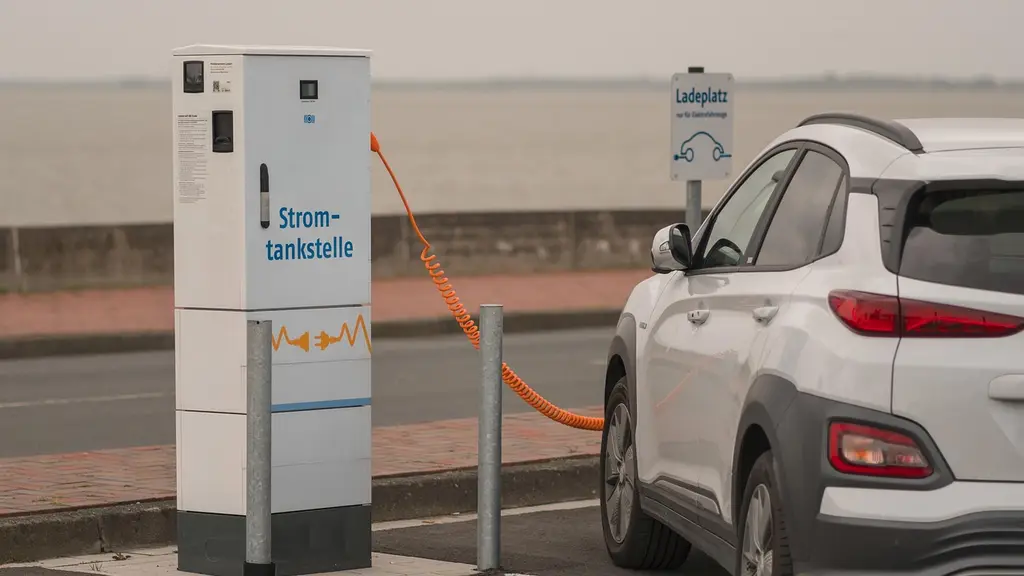
The electrical demand of e-bike charging is modest. The challenge is not power; it is where batteries are charged and how fire risk is managed.
Worked example: energy and power for a bike store
Consider an illustrative e-bike with a 500 Wh battery and a charger delivering 42 V at 4 A.
Charger output power = 42 V × 4 A = 168 W
Charging time ≈ battery energy ÷ charging power = 500 Wh ÷ 168 W ≈ 3 h (plus a slower taper near full)
If the charger is about 85% efficient, a full charge draws roughly 500 ÷ 0.85 ≈ 590 Wh from the mains. A commuter riding 3,000 km a year at an assumed 10 Wh/km would use about 30 kWh at the battery, or roughly 35 kWh from the grid. At an illustrative €0.30/kWh, that is around €11 a year. You can test your own assumptions with our battery charging cost calculator.
For a building manager, the more relevant number is simultaneous demand. If a secure store for 40 bikes provides sockets and every bike were charging at once at about 170 W, the peak would be roughly 6.8 kW, comparable to a single domestic electric vehicle charge point. In practice, diversity (not every bike charging at the same time) reduces the design load, but circuits should be designed by a qualified electrician to the relevant wiring regulations, with residual current protection and sockets positioned away from water and trip hazards.
Fire-safe charging spaces
Lithium-ion battery fires are rare relative to the number of batteries in use, but they are intense, can spread quickly and release toxic gases. The London Fire Brigade's #ChargeSafe campaign identifies charging as the riskiest time and advises against charging while asleep or away, and against charging where a fire would block an escape route. For infrastructure, this translates into a few design principles:
- Keep charging out of escape routes. Communal corridors, stairwells and entrance lobbies are the wrong place for battery charging.
- Separate and detect. A dedicated bike store or charging room should be fire-separated from the rest of the building where practicable, with appropriate detection; seek advice from a fire engineer and the local fire authority.
- Allow only certified equipment. Rules for communal charging should require the manufacturer's charger or a certified replacement, and prohibit modified or converted batteries.
- Consider battery lockers. Purpose-built charging lockers for removable batteries can contain a failure better than open sockets in a room full of bikes.
Safety: Never open, repair or rebuild a lithium-ion e-bike battery yourself, and never use an unbranded or mismatched charger. If a battery is swollen, damaged, unusually hot or smells of solvent, stop using it and follow the manufacturer's guidance. For a detailed explanation of failure mechanisms, see [battery safety and thermal runaway](/articles/battery-safety-and-thermal-runaway/).
Regulation is also catching up with the battery itself. The EU Batteries Regulation (EU) 2023/1542 creates a specific category for batteries in light means of transport (LMT), including e-bikes, with separate collection targets for waste LMT batteries (51% by the end of 2028 and 61% by the end of 2031) and, from 18 February 2027, a requirement that LMT batteries and their cells be readily removable and replaceable by an independent professional. Collection points for used e-bike batteries are part of the infrastructure picture too.
Routes: designing for faster, longer trips
E-bikes extend the distance people are willing to ride and flatten hills. That shifts route planning in several ways:
- Plan for longer catchments. Corridors connecting suburbs and towns several kilometres apart become realistic cycling routes, which strengthens the case for continuous, direct cycle highways rather than fragmented local links.
- Provide adequate width. A mix of riders at different speeds needs room to overtake safely. Design guides such as LTN 1/20 relate recommended widths to expected cycle flows; capacity planning should anticipate growth driven by e-bikes.
- Separate from pedestrians where volumes justify it. Higher average speeds increase conflict on shared-use paths. Segregated tracks avoid that conflict and are more comfortable for everyone.
- Design junctions for the speeds people will actually ride. Sightlines, curve radii and approach geometry should reflect realistic e-bike speeds.
- Keep surfaces smooth and well drained. Heavier bikes and higher speeds make potholes and loose surfaces more hazardous.
Hills deserve a special mention. In many cities, gradients have historically suppressed cycling in particular districts. Assistance makes those districts reachable, so network plans based on historic cycling counts may underestimate future demand there. Our article on urban cycling infrastructure covers network design in more depth.
Bringing the layers together
Infrastructure works as a system. Secure parking without a safe charging solution pushes batteries into flats and corridors; good routes without secure parking at the destination leave people unwilling to ride an expensive bike. The most effective schemes plan all three together and link them to public transport.
Try this: for a workplace or residential block, list the number of cycle spaces, the share that are ground-level and wide enough for e-bikes and cargo bikes, whether charging is permitted and where, and the nearest safe route connection. Gaps usually become obvious within minutes.
Planning checklist
- Provide a meaningful share of ground-level, wide parking spaces; do not rely solely on two-tier racks or hooks.
- Make long-stay parking secure: access control, lighting, surveillance and robust stands.
- Decide deliberately where batteries may be charged, keep charging out of escape routes, and involve a fire engineer in the design of any charging room.
- Size electrical supply for realistic simultaneous charging and have it installed by a qualified electrician.
- Require certified chargers and prohibit modified batteries in building rules.
- Design routes for longer trips, higher average speeds and mixed-speed overtaking, with segregation where flows justify it.
- Include battery collection and recycling points in the plan; more detail is in our guide to battery care for e-bikes and electric motorcycles.
References
- Cycle infrastructure design (Local Transport Note 1/20). UK Department for Transport
- E-bikes in the Mainstream: Reviewing a Decade of Research (Transport Reviews, 36(1), 72–91, 2016). Fishman and Cherry, Taylor & Francis
- Regulation (EU) No 168/2013 on the approval and market surveillance of two- or three-wheel vehicles and quadricycles. EUR-Lex, Publications Office of the European Union
- Regulation (EU) 2023/1542 concerning batteries and waste batteries. EUR-Lex, Publications Office of the European Union
- E-bikes and e-scooters: #ChargeSafe. London Fire Brigade