Baggage Handling Systems and Energy Use
Where baggage handling systems use energy, why idle running dominates, and how stop-start control, efficient gearmotors, drives and monitoring cut consumption.
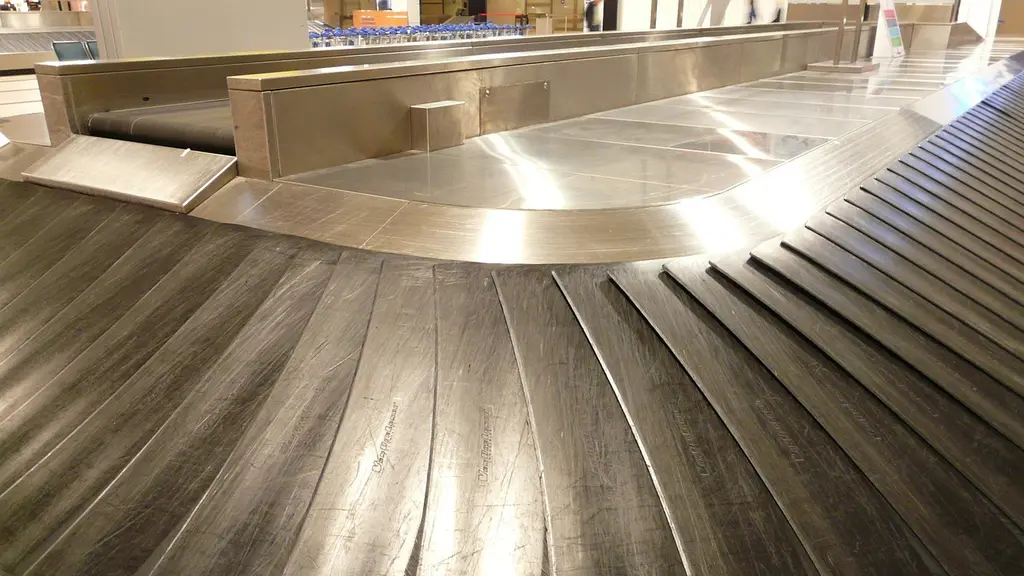
Behind the check-in desks of a large airport lies something closer to a parcel-sorting plant than a public building. A baggage handling system (BHS) may contain kilometres of conveyors, vertical sorters, tilt-tray or cross-belt sorters, early bag stores, and security screening machines, all coordinated by control software that tracks every bag from check-in to aircraft. At major hubs, thousands of electric motors may be installed.
Individually, most of those motors are small. Collectively, they add up to a significant electrical load, and they share a characteristic that makes them a prime efficiency target: for much of the day, many of them run with nothing on them.
This article explains where BHS energy goes, quantifies the physics of conveyor drives, and sets out the measures that reduce consumption without compromising the system's core job of getting every bag to the right aircraft on time.
What is inside a baggage handling system
A typical departures system includes:
- Check-in and induction conveyors, which weigh, label and feed bags into the system
- Collector and transport conveyors, often long runs linking check-in islands to the sortation area
- Hold baggage screening, increasingly based on computed tomography (CT) explosive detection systems
- Sorters, such as tilt-tray, cross-belt or individual carrier systems, which route bags to make-up positions
- Early bag storage for passengers who check in hours before departure
- Make-up and reclaim carousels where bags are loaded into containers or presented to arriving passengers
Arrivals systems are simpler, mainly transport conveyors and reclaim carousels, but they too often run for long periods between flights.
The physics of moving a bag
For a horizontal belt conveyor, the mechanical power needed at the belt is roughly:
Pmech ≈ μ · g · (mmoving + mbags) · v
where μ is the effective friction coefficient (belt on slider bed or rollers), mmoving the equivalent mass of belt and rotating parts, mbags the mass of bags on the section and v the belt speed. Inclined conveyors add a lifting term, mbags · g · v · sin θ.
The electrical input is mechanical power divided by the efficiencies of gearbox and motor:
Pelec = Pmech / (ηgearbox · ηmotor)
Worked example: one conveyor section
Consider an illustrative 10 m horizontal conveyor section running at 0.6 m/s, carrying five 20 kg bags, with an equivalent moving mass of 60 kg and an effective friction coefficient of 0.3.
- Loaded: Pmech = 0.3 × 9.81 × (60 + 100) × 0.6 ≈ 283 W
- Empty: Pmech = 0.3 × 9.81 × 60 × 0.6 ≈ 106 W
Now compare drivetrains:
- Helical-bevel gearbox (assumed 90% efficient) with a small motor (80%): loaded input ≈ 283 ÷ 0.72 ≈ 390 W
- Worm gearbox (assumed 60%) with the same motor: loaded input ≈ 283 ÷ 0.48 ≈ 590 W
Two insights emerge. First, an empty belt still needs over a third of the loaded mechanical power, plus motor and gearbox losses that do not fall to zero, so idle running is far from free. Second, gearbox type alone can raise input power by about half (590 W against 390 W). Worm gearboxes are compact and inexpensive but can be considerably less efficient than helical or helical-bevel designs, particularly at high reduction ratios and low loads.
The idle problem
Baggage flows are lumpy. Check-in peaks follow the departure schedule; arrivals carousels see bursts as flights land. Systems designed for peak hours carry a fraction of that load most of the time, and in many installations whole lines run continuously throughout operating hours.
Modern control strategies address this:
- Stop-start (sleep) mode: sections stop after a timeout when no bags are detected and restart when a bag approaches, while the control system maintains bag tracking.
- Speed reduction: variable-speed drives slow conveyors during low-flow periods instead of stopping them, avoiding frequent starts.
- Zone shutdown: whole lines, sorters or carousels are switched off outside their scheduled operating windows, linked to flight and allocation data.
- Soft starting: drives limit starting current and mechanical shock, reducing wear when stop-start is used.
Designers must balance energy savings against system performance. Restart delays can affect throughput at peak times, and each start imposes some wear. Well-tuned systems use short timeouts on lightly used sections and avoid stop-start where it would cause bags to collide or lose tracking.
Motors, gearboxes and drives
Motor efficiency classes are defined internationally in IEC 60034-30-1 (IE1 to IE4, with IE5 defined separately). In the European Union, Regulation (EU) 2019/1781 requires three-phase motors from 0.75 kW to 1,000 kW to meet at least IE3 from July 2021, introduced IE2 requirements for smaller motors from 0.12 kW in 2023, and requires IE4 for motors from 75 kW to 200 kW from July 2023. Most BHS motors are small, typically well under 5 kW, so they fall into the lower power bands where efficiency differences between classes are proportionally largest.
| Component | Typical issue | Improvement |
|---|---|---|
| Motor | Older low-efficiency motors; oversizing | IE3 or better motors sized to actual duty |
| Gearbox | Low-efficiency worm gears | Helical or helical-bevel gearmotors |
| Drive | Direct-on-line starting, constant speed | Variable-speed drives with soft start and sleep modes |
| Belt and bed | High-friction slider beds, mistracking | Low-friction beds or rollers; correct tension and tracking |
| Controls | Lines running outside schedules | Flight-linked zone control and timeouts |
Because a BHS contains so many identical units, a single specification decision, such as gearbox type, is multiplied hundreds or thousands of times.
Screening and sortation
Hold baggage screening machines, particularly CT-based explosive detection systems, draw substantial continuous power for X-ray generation, computing and cooling. Standby or low-power modes, where approved by manufacturers and security regulators, can reduce consumption during quiet periods, but security requirements always take precedence. Sorters such as tilt-tray and cross-belt systems are often among the largest individual BHS loads; running them only when needed, and at speeds matched to throughput, is a significant lever.
Individual carrier systems (ICS), where each bag travels in its own tote on a track, offer precise tracking and can reduce mishandling. Their energy performance depends heavily on design and control, so comparisons with conventional conveyors should be made project by project rather than assumed.
Worked example: an illustrative system-wide estimate
Consider an illustrative departures BHS with 800 conveyor sections averaging 0.5 kW electrical input while running.
- Connected running load: 800 × 0.5 = 400 kW
- If all sections run 20 hours a day: 400 × 20 × 365 ≈ 2.92 GWh per year
Now apply two measures:
- Stop-start control halves average running hours: consumption falls to about 1.46 GWh.
- Replacing worm gearmotors with helical-bevel units cuts running power by about a third (from the 0.48 to 0.72 drivetrain efficiency in the earlier example): consumption falls to about 0.97 GWh.
The combined reduction is roughly two-thirds. These numbers are illustrative; actual savings depend on the existing equipment, flow patterns and control strategy, and should be verified with metering before and after.
Measure before you model. Metering the BHS as a separate system, ideally down to major lines and sorters, reveals how much energy flows at night, between banks and during peak hours. Our article on designing a sub-metering strategy covers how to plan this.
Monitoring, maintenance and diagnostics
Energy and reliability go hand in hand. Misaligned belts, failing bearings and overtightened belts all increase friction and energy use before they cause failures. Motor current monitoring, already available in many drives, can reveal both. Approaches described in our article on predictive maintenance for building services apply directly to BHS drives.
Energy data can also trigger alerts when lines run outside schedules or draw more power than expected, using techniques covered in automated alarms for energy waste.
Historical airport energy research focused largely on terminal HVAC rather than baggage systems. The European FP7 project CASCADE (2011–2015), for example, combined ISO 50001-based energy management with fault detection for HVAC at Rome Fiumicino and Milan Malpensa, and is preserved in the CASCADE archive. Its underlying principle, continuous monitoring to detect equipment operating when or how it should not, translates well to baggage systems.
A BHS energy checklist
- Sub-meter the BHS separately from the terminal, with further metering on major lines and sorters
- Map operating hours of each zone against actual flight and baggage flow data
- Enable stop-start or speed reduction on lightly used sections, with timeouts tuned to protect tracking and throughput
- Specify efficient motors, helical-bevel gearmotors and variable-speed drives in new projects and replacements
- Check belt tracking, tension and bed friction during routine maintenance
- Review screening machine standby options with manufacturers and security authorities
- Report BHS energy per bag processed as a performance indicator for the system as a whole; see our wider overview of energy efficiency in airports
Key takeaways
- Baggage systems contain many small motors that often run with no bags on them.
- Idle running and low-efficiency drivetrains are the two largest sources of avoidable consumption.
- Stop-start and speed control can cut running hours substantially when tuned carefully.
- Specification choices are multiplied across hundreds of identical units, so getting them right matters.
References
- Electric motors and variable speed drives (EU energy-efficient products). European Commission
- Commission Regulation (EU) 2019/1781 on ecodesign requirements for electric motors. International Energy Agency (policy database)
- IEA 4E Technology Collaboration Programme (Electric Motor Systems). IEA 4E TCP
- CASCADE: reducing energy use by airports. CORDIS, European Commission